Lajes
The WhaleLajes is the oldest town on Pico and a place where the book brings the geological force of the Azores into close contact with their whaling history. On the island’s southern shore, the town is framed by a restless volcano and the Atlantic; within its streets, churches, cafés, and museum, whales remain visible as religious objects, local emblems, and evidence of an industry that persisted into the late twentieth century.
Setting between sea and volcano
The Azores lie in the Atlantic Ocean, about 1,500 miles east of Cape Cod and 1,000 miles from Lisbon. The nine islands are the exposed peaks of immense submarine mountains, situated across the Eurasian, African, and American plates. This shifting geography gives the archipelago a physical instability that shapes the account of Lajes: earthquakes recur, and Pico’s volcano remains active. Pico itself is relatively young, having appeared about a quarter of a million years ago.
Lajes occupies Pico’s southernmost shore and is described as the island’s oldest town. The narrator’s walk through its dark streets before dawn places the settlement between two elemental presences: the volcano rising above it and the surf along the coast. The town is not presented as a sheltered refuge from the ocean. Its position instead makes sea and earth the conditions under which local life has developed.
The approach to the islands reinforces that sense of exposure. Ferries leave Faial carrying supplies and passengers’ luggage, crossing narrow straits over Atlantic swells. The water drops to great depths close to shore. In this setting, Lajes belongs to a landscape where the familiar scale of a town meets an abrupt underwater world, and where the sea is both a route of connection and a source of apprehension.
Belief and the everyday whale
The town’s religious architecture gives this maritime setting a distinct local form. At one end of Lajes stands the small chapel of São Pedro, founded in 1460 and built into and from basalt. At the other is an eighteenth-century Franciscan monastery. Together they make belief part of the town’s material landscape, while the black volcanic stone connects its buildings to Pico’s geological character.
Whales also appear throughout ordinary public space. Pavement mosaics, shop souvenirs, and café signs make them part of the town’s visual vocabulary. One bar displays a sperm whale’s lower jaw above its bottles. In a glass cabinet beneath the twin towers of the Santissima Trinidade, scrimshaw harpoon models are arranged toward a crucified Christ beside a small votive whale. The objects bring hunting, devotion, and commemoration into the same frame: the whale is at once an animal pursued for its value and an emblem addressed through religious practice.
The book links this imagery to the history of whaling in the Azores. It notes that a reported apparition of Our Lady of Lourdes in France in 1858 coincided with the commencement of whaling in the islands. Elsewhere in the account, Azoreans are said to have begun their own whaling in 1850, so the two dates are presented as part of a cultural association rather than a single unambiguous start date. In either case, the devotional display at Lajes preserves a local memory in which whales entered both economic life and religious symbolism.
Whaling and Atlantic migration
The Azorean whaling economy grew from contact with American ships sailing on the trade winds. Ships including the Charles W. Morgan called at the islands for fresh provisions and crew. Azoreans in turn worked passages aboard whaling ships bound for the New World. The same prevailing winds did not carry those ships back by the islands on their return voyages, and many Azoreans settled in America. The book estimates that Portuguese or Azorean ancestry is present in half the population of the Massachusetts seaboard and describes the islands’ towns as architectural echoes of American whaling ports, adapted to a landscape with palm trees.
Lajes’s connection to that migration is made personal through the recognition of familiar surnames and accents. The narrator encounters names also known from Provincetown and a taxi driver speaking English with a New Bedford accent. These details make the Atlantic crossing legible in the town itself: movement between the islands and American ports has left traces in family names, speech, and local identity, not only in maritime records.
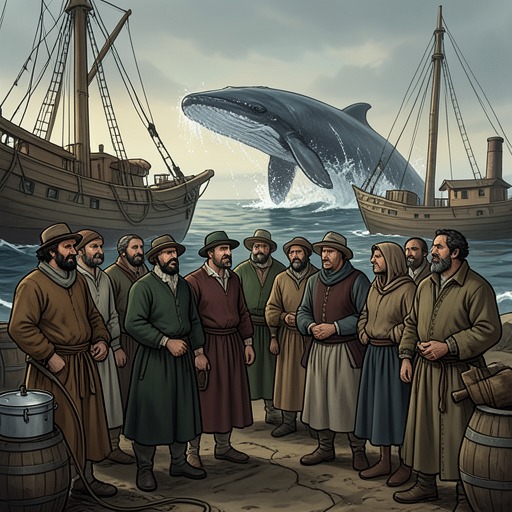
In 1850, Azoreans began whaling on their own terms, using knowledge learned from former American whaling crews. The industry expanded until about one hundred Azorean crews were hunting whales. It was not simply a preserved custom from a distant era: commercial whaling in the Azores continued until 1986. That late endpoint narrows the historical distance between the island’s present-day whale emblems and the working practices that produced them.
A local record of the industry
A little outside Lajes, a converted boathouse houses the Museu do Cachalotes e Lulas, an idiosyncratic collection assembled through Malcolm Clarke’s interest in whales and the animals they eat. Clarke, born in Birmingham and raised near the River Thames, served in the Royal Army Medical Corps before joining whaling fleets in the South Atlantic and Southern Ocean in the 1950s. His memories connect the museum to industrial whaling on a scale difficult to grasp: in one season he saw thirty thousand whales taken, and the fleet sometimes caught twenty-four in a day.
Clarke’s later scientific interest focused on the contents of sperm whales’ stomachs. The museum’s collection includes squid beaks, among them a find of 18,000 beaks from a single whale. A life-size painted cross-section of a female sperm whale extends across the museum walls, turning the building into a display of anatomy and feeding ecology. These exhibits preserve knowledge generated by the hunt while also recording the extraordinary quantities of marine life encountered through it.
The museum therefore complicates any view of Lajes as a place where whaling survives only as picturesque heritage. Its exhibits and Clarke’s testimony retain evidence of mass extraction, while the town’s mosaics, votive objects, and whale-shaped souvenirs register how deeply the animal entered public memory. In Lajes, the whale is neither only a sacred sign nor only a former commodity: it marks the continuing relationship between island life, migration, belief, and an industry that ended within living memory.